
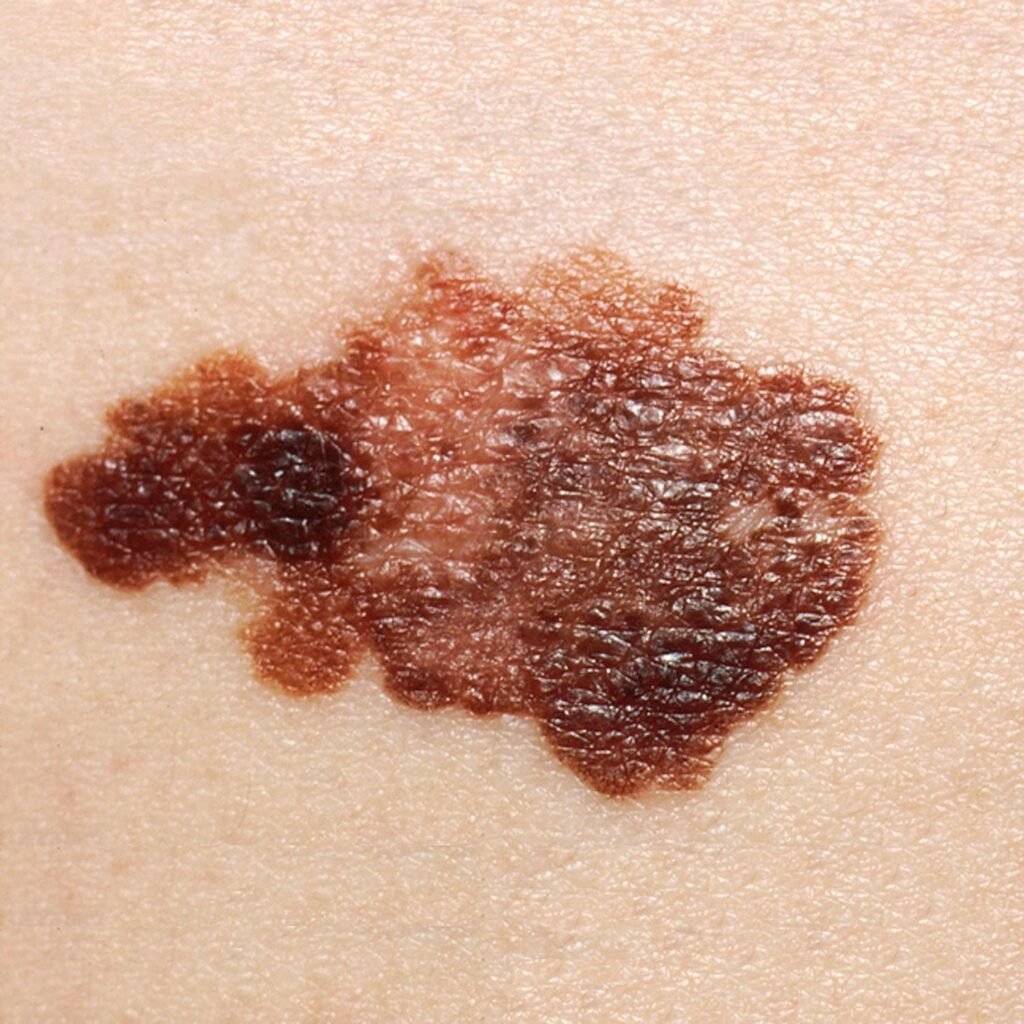
A new development in cancer research is attracting attention across the United States after Moderna and Merck announced positive results from a large Phase 3 trial of a personalized mRNA-based cancer treatment for melanoma.
The experimental treatment, called intismeran autogene, is designed specifically around mutations found in an individual patient’s tumor. When used alongside Merck’s immunotherapy Keytruda (pembrolizumab), the treatment reduced the risk of melanoma returning and also reduced the risk of the cancer spreading to distant parts of the body compared with Keytruda alone.
The companies said the Phase 3 INTerpath-001 trial met both its primary endpoint of recurrence-free survival and its key secondary endpoint of distant metastasis-free survival.
What Happened in the New Melanoma Vaccine Trial?
The INTerpath-001 trial enrolled 1,137 patients with completely removed, high-risk stage IIB through IV melanoma.
Researchers randomly assigned participants to receive either Keytruda alone or Keytruda with the individualized mRNA treatment. Doctors gave the treatment after surgery to reduce the chance that remaining microscopic cancer cells would cause the disease to return.
According to Moderna and Merck, the combination produced statistically significant improvements in both recurrence-free survival and distant metastasis-free survival. The companies also reported that no new safety signals had emerged from the trial at the time of the announcement.
However, the companies have not yet released the full numerical Phase 3 results. More detailed data are expected to be presented at a future medical meeting, so the early announcement should not be interpreted as proof that the treatment will work for every melanoma patient.
How Does a Personalized mRNA Cancer Treatment Work?
Unlike a conventional preventive vaccine, this treatment is being developed as a therapeutic cancer vaccine.
The process begins with the patient’s tumor. Researchers analyze genetic mutations in the tumor and identify abnormal proteins, known as neoantigens, that can help distinguish cancer cells from healthy cells.
The personalized treatment is then designed to provide the immune system with instructions for recognizing those cancer-specific targets.
The goal is straightforward: teach the immune system to recognize characteristics of a patient’s cancer and attack cells carrying those characteristics.
Moderna describes intismeran as an individualized neoantigen therapy, meaning that the treatment is designed around the genetic characteristics of an individual’s tumor rather than using exactly the same vaccine for every patient.
Why Is the Result Important?
Cancer vaccines have been studied for decades, but producing meaningful improvements in large clinical trials has been difficult.
The new Phase 3 result is therefore significant because it provides late-stage evidence that an individualized mRNA treatment can add benefit when combined with an established immunotherapy.
Reuters reported that this is the first positive late-stage trial result for an mRNA cancer vaccine and the first such study to show that adding the personalized treatment to Keytruda improved outcomes in patients whose melanoma had been surgically removed.
Earlier five-year results from the Phase 2b KEYNOTE-942 study had already provided encouraging evidence. In that study, the intismeran-Keytruda combination was associated with a 49% reduction in the risk of recurrence or death and a 59% reduction in the risk of distant metastasis or death compared with Keytruda alone.
The Phase 3 announcement now provides another important step in evaluating whether that earlier promise can translate into a larger patient population.
What Are Real Experts and Industry Leaders Saying?
Stephen Hoge, Moderna President
Moderna President Stephen Hoge described the new result as a landmark development.
In comments reported by Reuters, Hoge said:
“This is the first time that we’ve seen really clinically significant, statistically significant improvements over checkpoints like Keytruda in this population.”
He also said that thousands of patients who have undergone surgery for high-risk melanoma could potentially benefit if the treatment receives regulatory approval.
Stéphane Bancel, Moderna CEO
Moderna CEO Stéphane Bancel also emphasized the significance of creating an mRNA treatment specifically designed around an individual’s cancer.
In the company’s announcement, Bancel said:
“These Phase 3 findings represent a pivotal moment for the field of cancer research.”
He described individualized cancer treatment as something that had previously been aspirational and said the companies are now helping turn that concept into reality.
Dean Li, Merck Research Laboratories
Dean Li, president of Merck Research Laboratories, said the Phase 3 findings reinforce the potential of a more personalized approach to treating melanoma.
Li said:
“We believe individualized neoantigen therapies have the potential to redefine how patients with completely resected stage IIB-IV melanoma are treated.”
His comments were reported by MarketWatch following the announcement.
Myles Minter, William Blair Analyst
The response from financial and biotechnology analysts has also been strongly positive, although analysts have noted that the detailed clinical data are still needed.
Myles Minter, an analyst at William Blair, said the results position Moderna and Merck well for pursuing regulatory approval. He also indicated that the positive melanoma result could have implications for the companies’ studies of the treatment in other cancers.
What Does This Mean for Melanoma Patients?
For patients who have had high-risk melanoma surgically removed, one of the major concerns is recurrence.
Even when visible cancer has been removed, microscopic cancer cells can sometimes remain in the body. These cells can eventually grow and cause the cancer to return or spread.
That is why treatments given after surgery, known as adjuvant treatments, are important.
The potential advantage of a personalized cancer vaccine is that it could give the immune system an additional set of instructions for identifying cancer cells after surgery.
The new trial does not mean that every melanoma patient should receive an mRNA cancer vaccine. Intismeran remains an investigational therapy, and regulatory authorities still need to evaluate the complete clinical evidence before it could become an approved treatment.
Is the mRNA Cancer Vaccine Approved Yet?
No.
Intismeran is still an investigational treatment. Moderna and Merck have announced the positive Phase 3 topline results and said they are engaging with regulatory authorities.
The full Phase 3 results have not yet been publicly released in detail, meaning patients and doctors still need to wait for the complete data and regulatory review.
This distinction is important because a successful clinical-trial announcement is not the same thing as FDA approval.
What About Safety?
The companies said the Phase 3 trial did not identify any new safety signals at the time of the announcement. Earlier studies of the treatment reported side effects including fatigue, injection-site pain, chills, fever and headache.
In the five-year Phase 2b follow-up, serious adverse-event rates were broadly similar between the combination-treatment and Keytruda-alone groups.
Still, the complete Phase 3 safety information will be important. Patients should not change or stop cancer treatment based on news reports and should discuss treatment options with their oncologist.
Could Personalized Cancer Vaccines Work Against Other Cancers?
Researchers are already studying individualized mRNA cancer treatments beyond melanoma.
Moderna and Merck have a broader clinical program evaluating intismeran in additional cancer settings, including studies involving lung cancer and other tumor types. The success in melanoma could provide additional support for investigating the technology in those diseases, although success in one cancer does not guarantee success in another.
One of the most interesting aspects of this development is that the technology uses genetic differences between tumors to help researchers create highly individualized cancer treatments.
What Happens Next?
The immediate next steps are likely to focus on the complete Phase 3 data and discussions with regulators.
Doctors and researchers will want to see the detailed numbers behind the announcement, including:
- How large the reduction in recurrence risk was
- How much the treatment reduced the risk of distant metastasis
- Overall survival results as the trial matures
- Detailed safety information
- Which patient groups benefited the most
- How practical and affordable individualized production will be
The companies will also need regulatory approval before the treatment can become broadly available.
Why This Could Be a Major Moment for Cancer Research
The significance of this development goes beyond melanoma.
For years, researchers have explored how they can customize vaccines to target the unique characteristics of an individual’s cancer. The latest Phase 3 result suggests that mRNA technology may finally be producing meaningful clinical results in this area.
The treatment is not a universal cancer vaccine, and it is not yet an approved cure for melanoma. But the combination of genetic tumor analysis, personalized neoantigens, mRNA technology and immunotherapy represents a rapidly developing area of modern oncology.
For patients and families affected by melanoma, the development offers a reason for cautious optimism while the scientific community waits for the complete Phase 3 results.
Bottom Line
Moderna and Merck’s personalized mRNA cancer treatment has achieved an important milestone by meeting the main efficacy goals of a Phase 3 melanoma trial.
The treatment, intismeran autogene, targets mutations in an individual’s tumor, and researchers are testing it alongside Keytruda after melanoma surgery.
The results look promising, but the FDA has not yet approved the treatment, and researchers still need to review the complete clinical data.
For now, the development represents an important step toward a future in which cancer treatment could become increasingly personalized to the biology of each patient’s tumor.
Medical note: This article is for news and educational purposes and does not provide medical advice. Anyone diagnosed with melanoma should discuss treatment decisions with a qualified oncology team.